

How to Communicate Capital Project Prioritization to Business Leaders
With seven communication tips every capital program leader needs.

Capital project prioritization is more than a technical exercise. Business leaders want clarity and confidence that the organization is investing in the right things, while technical professionals want a fair and transparent process. Bridging those expectations takes disciplined fundamentals, consistent application, and communication that holds up when the inevitable questions begin. Most prioritization efforts struggle at this point, and that is where the real work starts.
Seven Secrets of Capital Program Prioritization
Effective capital program prioritization is about applying disciplined fundamentals with consistency. Organizations also make better decisions and avoid unnecessary churn. Utility, facility, and infrastructure owners who treat prioritization as an integrated process rather than a once‑a‑year exercise build capital programs that are defensible, fundable, and aligned with long‑term system needs. In the end, you get more of what you need.
Project Definition
Prioritization Methodology
Timing (and Cash Flow)
On-going Projects and Project Dependencies
Project Size
Special Projects and Studies
Where to Draw the Budget Line

Seven Secrets for Success: A Practical Look at Capital Program Prioritization
From the Real World
The capital improvements program director had been frustrated. Every time she thought she had the project prioritization tool right, the director of engineering or the director of technology wanted to change it.
Finally, I had gotten a team together to use two different project prioritization tools, not just one. The results were insightful.
“It looks like we have good agreement for the rankings by each method,” I stated to the director of technology, and paused. “Except for these three projects on the forced ranking.”
“Well, these two are mine, and most of the people in the room know I am going to do them,” came the reply.
“And the other one is mine,” quipped the director of engineering. “We’re going to do that one no matter what the model says.”
So, you don’t believe in the model, I asked.
“Oh, we believe in the model for most of the projects,” stated the engineering director. “We are just going to modify the calculations until we get what we intend to do.”
Two Primary Ways to Prioritize
Unfortunately, the above real-world case is very common. We spend a lot of time developing and validating project prioritization tools that oftentimes are accurate but don’t deliver what some senior managers want.
Deciding what is most important can be difficult. Deciding what is most important as a group is usually difficult and frustrating. However, the same prioritization techniques you use as an individual can be applied to gain quick, easy agreement among a group. Good, transparent prioritization underpins good communication.

Choosing the Right Prioritization Approach Enables Effective Communication
Forced Ranking Is Straightforward
The first prioritization approach is forced ranking. This is what we do when deciding what to eat for lunch. Whether it is chicken, a hamburger, or pizza, we can normally rank our preferences quickly in 1–2–3 order.
Individuals prioritize their choices by ranking them or by evaluating features.
Multiple Criteria Adds Complexity
The second approach involves establishing multiple criteria for each item. Again, using the lunch example, these criteria could include “fewer calories,” “less wait time,” or “something different than I ate yesterday.” Evaluating alternatives using multiple criteria is a form of problem disaggregation, a common problem-solving technique that has existed for centuries.
The multiple criteria approach is a common consensus-building tool for groups.
Both Approaches Are Viable
We often forget that these two approaches equally apply to problem solving in groups — whether the group is a business group, a family group, or a group of friends. The major difference is that decision making in groups requires some form of consensus, whereas decision making as an individual requires a simple choice. Getting to a consensus in a group requires more structure and more formality.
The Solution: Use Both Approaches
So, which approach is better? The simple answer is that they are equally good. Context matters.
I usually use both approaches for capital project prioritization. First, it doesn’t take that much time to do a forced ranking exercise. Second, everyone gains insights about why certain projects were ranked differently (see the Seven Secrets above). And third, the understanding gained from doing both help communicate the results more effectively.
Challenging the Results
Everyone wants to see the results. That’s why business leaders will not criticize the elements of the process as it goes along, even if you get them involved in it.
I’ll add that I do like getting as many senior managers or board members involved in the process as possible. But it’s more for awareness and communication, not for validation or cornering them into the model results. Again, no one is going to have a strong opinion until they see the results.
Once the results are in, the questions will start and the communication has to be sharp. We’re back to the Seven Secrets, but the real question is “why didn’t my favorite project make the list?” Once again, be ready to address these seven issues.
Prioritization Methodology
Timing (and Cash Flow)
On-going Projects and Project Dependencies
Project Size
Special Projects and Studies
Where to Draw the Budget Line
Communicating Capital Project Prioritization
Which approach to prioritization is better? How did you size the projects? What about the special study we need to chart the future? Did you incorporate the second phase of the project or just the first? All of these (and more) are good questions that you will hear.
Embrace the questions because they are coming, regardless of the technical preparation. Like most things, the key is to handle the technical aspects well and to adopt a formal communication approach that is integrated from day one.
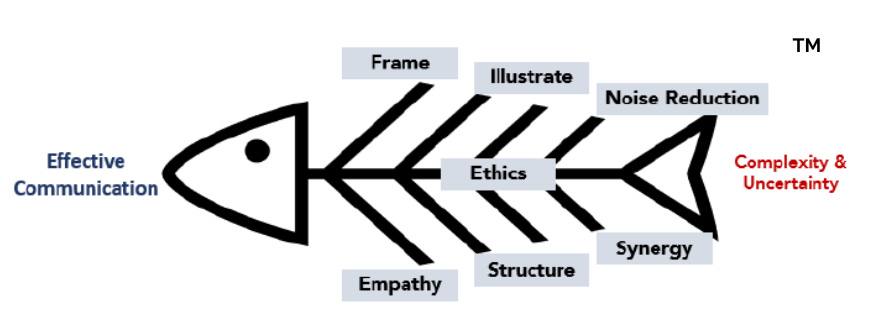
Communicating with the FINESSE Approach
The FINESSE Fishbone Diagram® is a structured approach designed to enhance effective communication, particularly in complex and uncertain situations, by focusing on seven cause-and-effect elements: Frame, Illustrate, Noise Reduction, Empathy, Structure, Synergy, and Ethics.
Frame
Tip: Frame by using a one-sheet standard project description for every project.
The information should at a minimum, include the project name, purpose, duration, budget, other project dependencies, and a geospatial inset of the project location. It’s amazing how many times this important step is left out.
Illustrate
Tip: Use comparative tables of the project rankings.
Compare the list of projects using multi-criteria and forced ranking. Do it for special criteria as well, such as safety or compliance. Use color coding for quick reference (green = projects with the same relative rank, yellow = moderate change based on approach or factor, and red = projects that differed substantially.
Noise Reduction
Tip: Use more tables and fewer words.
Business leaders will be looking for where their favored projects are. They couldn’t care less about your words, except to use them against you if they didn’t get what they wanted. Stand on the work. Fewer words in more.
Empathy
Tip: Acknowledge the importance of all projects.
All of the projects that were prioritized have some merit, or they would not have been on the list. Acknowledge that up front. Also acknowledge that your job was to put the best science into the process, and the ultimate decision is theirs, not yours.
Structure
Tip: Get the results to the executive sponsors before the presentation.
My best advice is to make sure the one or two executive sponsors get the results before everyone else. Leave it to them to decide how much information is shared before the big show. Use the three-act structure for the presentation.
Synergy
Tip: Align the results with the organization’s strategic goals.
The Strategic Plan is the best place to find the strategic goals. Align the prioritized projects with each goal, both in terms of the number of projects and the total dollar volume.
Ethics
Tip: Be transparent about your assumptions and methodologies.
Technical professionals serve as subject-matter experts but are not decision-makers. Share your assumptions and methodologies. Do not advocate for your preferred project.
How to Effectively Communicate Capital Project Prioritization
Communicating capital project prioritization is tricky. Front-line staff and business leaders are all looking for their favorite projects to be highly ranked. Getting the technical pieces right must be integrated with a proven communication approach, such as the FINESSE Fishbone Diagram®.
Need Help Refining Your Communication Related to Capital Projects?
Need help getting started? JD Solomon Inc. provides practical solutions for prioritizing and communicating capital projects and programs.
JD Solomon writes and consults on decision-making, reliability, risk, and communication for leaders and technical professionals. His work connects technical disciplines with human understanding to help people make better decisions and build stronger systems. Learn more at www.jdsolomonsolutions.com and www.communicatingwithfinesse.com.